

Sure, I can help with this!
**
Dữ kiện đề bài:
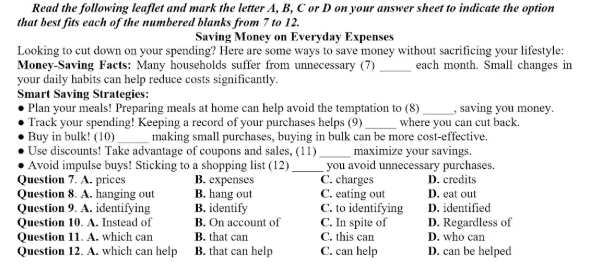
Đoạn văn bản tiếng Anh cần điền các từ/cụm từ còn thiếu vào các chỗ trống được đánh số từ 7 đến 12. Các lựa chọn A, B, C, D được cung cấp cho mỗi chỗ trống.
Bài giải:
Để hoàn thành bài tập này, chúng ta cần đọc kỹ từng câu, hiểu ngữ cảnh và chọn đáp án phù hợp nhất với ngữ pháp và ý nghĩa của câu.
-
Based on the leaflet provided in the image, here are the correct answers for each of the numbered blanks:
-
Question 7: B. expenses
-
Reasoning: “Unnecessary expenses” is a common financial collocation. Households suffer from spending too much on these, rather than “prices” or “charges”.
-
-
Question 8: D. eat out
-
Reasoning: The preposition “to” after “temptation” requires a base verb. The context is about food and meals, so “eat out” is the correct phrase.
-
-
Question 9: B. identify
-
Reasoning: The verb “help” can be followed directly by a bare infinitive (a verb without “to”). “Helps identify” is grammatically correct here.
-
-
Question 10: A. Instead of
-
Reasoning: The sentence contrasts two actions: “making small purchases” and “buying in bulk.” “Instead of” correctly sets up this alternative.
-
-
Question 11: A. which can
-
Reasoning: The comma before the blank indicates a non-defining relative clause. “Which” is used to refer back to the preceding clause (“Take advantage of coupons and sales”).
-
-
Question 12: C. can help
-
Reasoning: “Sticking to a shopping list” is the subject of the sentence, so it needs a main verb. “Can help” correctly completes the main clause (“Sticking to a shopping list can help you avoid…”).
-
-
Kiểm tra lại đáp án: Các đáp án đã chọn đều phù hợp với ngữ pháp và ngữ cảnh của từng câu, tạo thành một đoạn văn mạch lạc và có ý nghĩa về chủ đề tiết kiệm tiền.